
Dubai’s hospitality industry looks to the future

Dubai’s hospitality industry is entering a new phase of expansion, buoyed by surging international visitor numbers and record levels of investment. The emirate welcomed 18.7 million international overnight visitors in 2024, up 9.1% from the previous year and surpassing pre-pandemic levels, according to the Dubai 2024 Annual Visitor Report, published by the Department of Economy and Tourism.
By the end of 2024, Dubai’s hotel inventory stood at roughly 154,000 rooms across 832 properties, up from 150,000 rooms across 821 properties a year earlier. Despite the increase in room supply, occupied room nights rose 3% year-on-year (YoY) to 43.03 million, while revenue per available room (RevPAR) climbed 2% YoY to AED421 (US$114), highlighting the market’s strong fundamentals.
Dubai is expected to add at least 11,000 new guestrooms to its total inventory by 2027. The majority of these fall within the luxury and upper-upscale categories, segments that together account for nearly two-thirds of the city’s hotel supply.
While Dubai’s status as one of the world’s top hospitality markets continues to grow, industry analysts note a clear shift toward premium and experiential hospitality, as the city increasingly attracts international travellers seeking unique, high-value stays.
Ciel: Redefining premium and experiential hospitality
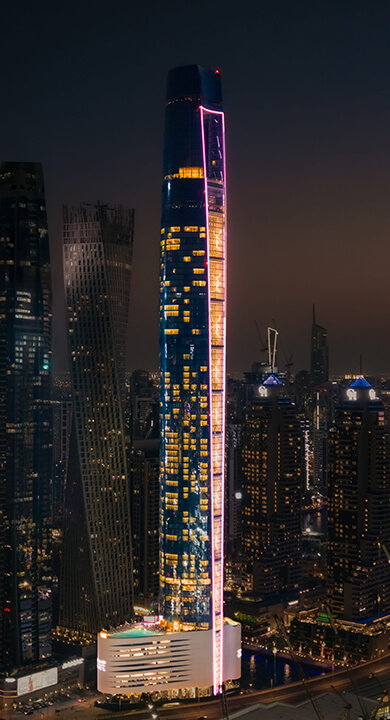
Few projects embody this trend more clearly than Ciel, the striking new landmark in Dubai Marina that will claim the title of world’s tallest hotel when it opens this month (November 2025).
Developed and operated by The First Group and a member of IHG Hotels & Resorts’ Vignette Collection, the 377-metre, 82-storey tower has transformed Dubai Marina’s iconic skyline while reinforcing the city’s reputation as one of the world’s hottest hospitality markets.
Beyond its record-breaking height, Ciel is designed as an immersive lifestyle destination. The hotel features the world’s highest infinity pool, with sweeping views of the Arabian Gulf and Palm Jumeirah, alongside a multi-level dining experience operated by Tattu, the award-winning modern Asian restaurant brand founded in the UK.
The concept spans three distinct venues – Tattu Restaurant & Bar, Tattu Sky Pool and Tattu Sky Lounge & Terrace – creating a seamless experiential hospitality journey that blends contemporary cuisine, striking design and elevated guest experiences high above the city.
Ciel also boasts a wellness spa, observation deck and curated lifestyle experiences created for international travellers seeking memorable, one-of-a-kind stays.
Industry observers say developments like Ciel reflect a broader market evolution.
“Dubai is diversifying its tourism offering and expanding its range of experiences for visitors with culture, adventure, business travel and food and wellness holidays,” KPMG stated in its 2025 Dubai Hospitality Report. The analyst notes that guests are increasingly seeking unique, personalised stays in hotels that deliver not just comfort but a sense of occasion.
With projects such as Ciel setting new global benchmarks for design and guest amenities, Dubai is expanding its appeal to discerning business and leisure travellers alike.
Strategic drivers and visitor diversification
The sector’s momentum aligns with the goals of the Dubai Economic Agenda (D33), which aims to position the emirate among the world’s top three tourism destinations by 2033. The strategy focuses on three key pillars to drive growth: attracting new visitor source markets and increasing the number of arrivals from core markets; developing sustainable tourism offerings; and expanding the number of mid-market and luxury hotels operating in the city.
According to KPMG, these efforts are already paying off. The decision to extend tourist visas for Indian nationals has boosted demand from one of Dubai’s most important source markets, with 70% of respondents in a recent survey saying they are now more likely to visit the UAE due to this change.
Asian markets, in particular, continue to drive growth. Visitor arrivals from Northeast and Southeast Asia rose by more than 24% YoY in 2024, supported by improved air connectivity and streamlined visa processes, further underscoring Dubai’s increasing global reach.
Industry forecasts suggest the UAE’s hospitality market will expand from US$27 billion in 2025 to US$35 billion by 2030, representing a compound annual growth rate of nearly 8%.
Driven by record visitor arrivals and high-profile developments such as Ciel, Dubai’s hospitality sector is consolidating its position as one of the most dynamic and competitive in the world.