
Why Dubai remains a standout market for hospitality investments

Periods of geopolitical uncertainty tend to test the resilience of global markets. In the Gulf, recent tensions have introduced a degree of caution across parts of the region, particularly in sectors linked to travel and trade.
Dubai, however, is navigating the current environment from a position of considerable strength. The emirate’s tourism and hospitality sectors are underpinned by a diversified visitor base, first-rate accommodation and attractions, and world-class infrastructure – including the busiest international airport on the planet — fundamentals that continue to support steady levels of activity.
This resilience has been repeatedly demonstrated. Over the past two decades, Dubai has navigated global and regional disruptions while maintaining growth, supported by a diversified economy, proactive governance and sustained investment in infrastructure.
For investors, the distinction lies in the emirate’s underlying trajectory. While near-term conditions may moderate activity, the fundamentals driving demand remain firmly intact – positioning Dubai to regain momentum quickly as the regional outlook stabilises.
It is this continuity that defines the emirate – well established, globally connected and structurally resilient to short-term shocks.
A globally connected, high-growth economy
Dubai’s strength lies in its position as a genuinely global hub. Its economy is built on connectivity – linking capital, trade and talent across Europe, Asia and Africa – and that positioning continues to drive growth.
Official data shows Dubai’s GDP grew by 5.4 percent YoY, reaching AED937 billion (US$255bn) in 2025, driven by expansion in key sectors including tourism, logistics and financial services.
Foreign direct investment (FDI) remains a central pillar, with Dubai securing 81% of the record US$33.2bn in greenfield FDI secured by the UAE in 2025 – equivalent to 1,202 of the 1,491 major foreign-funded projects launched nationwide.
Dubai’s world-class infrastructure and support for entrepreneurial talent have also made it one of the world’s most innovative cities. In 2025, the emirate rose eight places to rank fourth in the annual IMD Smart City Index, making it the highest-placed destination in the Middle East and Asia.
Dubai recorded progress in 16 out of 20 technology indicators and across all four pillars of technology governance assessed in the 2025 report, underscoring its commitment to continuous innovation and smart city excellence.
Dubai International Airport also consolidated its reputation as the world’s busiest international air hub in 2025, welcoming 95.2 million passengers. The landmark achievement not only marked the busiest year in the airport’s history, but the highest annual international passenger traffic ever recorded by any airport worldwide.
For investors, these fundamentals – sustained demand, global accessibility and a steady flow of inbound capital – reinforce confidence in Dubai’s long-term potential.
Hospitality at the centre of the investment story
Within this framework, hospitality stands out as one of Dubai’s most compelling investment sectors.
The city welcomed a record 19.59 million international visitors in 2025, extending a multi-year growth trend that has cemented its position among the world’s leading destinations.
This demand is reflected in the hotel industry’s stellar operating performance. In 2025, the citywide average occupancy rate rose 3% year-on-year (YoY) to an impressive 81%, while both average daily rates (ADR) and revenue per available room (RevPAR) recorded 8% and 11% YoY growth respectively – indicators of a market with both depth and pricing resilience.
At the same time, supply continues to expand in a measured way. With more than 154,000 hotel rooms now in operation and a strong development pipeline, Dubai remains one of the most active hospitality markets globally. Crucially, new inventory is being absorbed without undermining performance, supported by diversified demand across leisure, corporate and events-driven segments.
For hotel and hospitality investors, Dubai’s unique combination of high occupancies, upward rate growth and sustained demand remains a defining advantage.
A resilient market defined by long-term potential
Dubai’s resilience is underpinned not only by demand, but by the strength of its operating environment.
The emirate has consistently demonstrated its ability to navigate external pressures while sustaining growth, supported by targeted policy measures, continued investment in infrastructure and a regulatory framework designed to support business continuity. Recent government initiatives to enhance liquidity and ease operating costs reflect the same approach.
This environment has enabled experienced operators such as The First Group to scale in line with the market’s expansion, building an award-winning portfolio of lifestyle hotels that has contributed to Dubai’s emergence as a global hospitality destination.
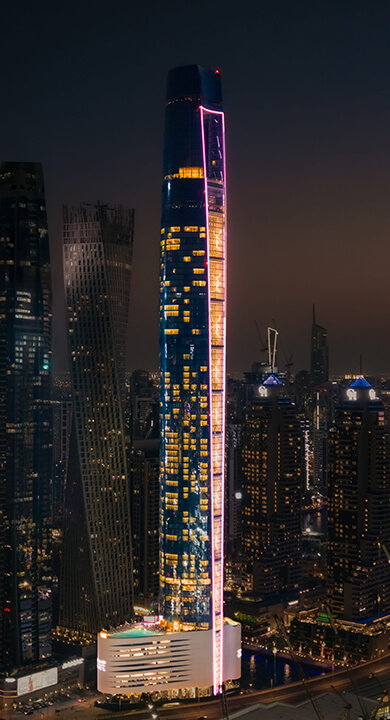
Flagship developments such as Ciel Dubai Marina, Vignette Collection by IHG – officially recognised as the world’s tallest hotel – reflect both the ambition of the market and The First Group’s capacity to deliver complex, groundbreaking projects in one of the world’s most competitive hotel landscapes.
For investors, this track record highlights a market where development, operations and long-term performance are supported by both demand fundamentals and a mature, well-regulated ecosystem.
Ultimately, Dubai’s enduring appeal lies in this consistency. While short-term conditions may fluctuate, the city’s underlying drivers of growth remain firmly in place.
As regional conditions stabilise, the emirate is ideally positioned not only to regain momentum, but to build on it — reinforcing its status as one of the world’s leading destinations for tourism, business and investment.